
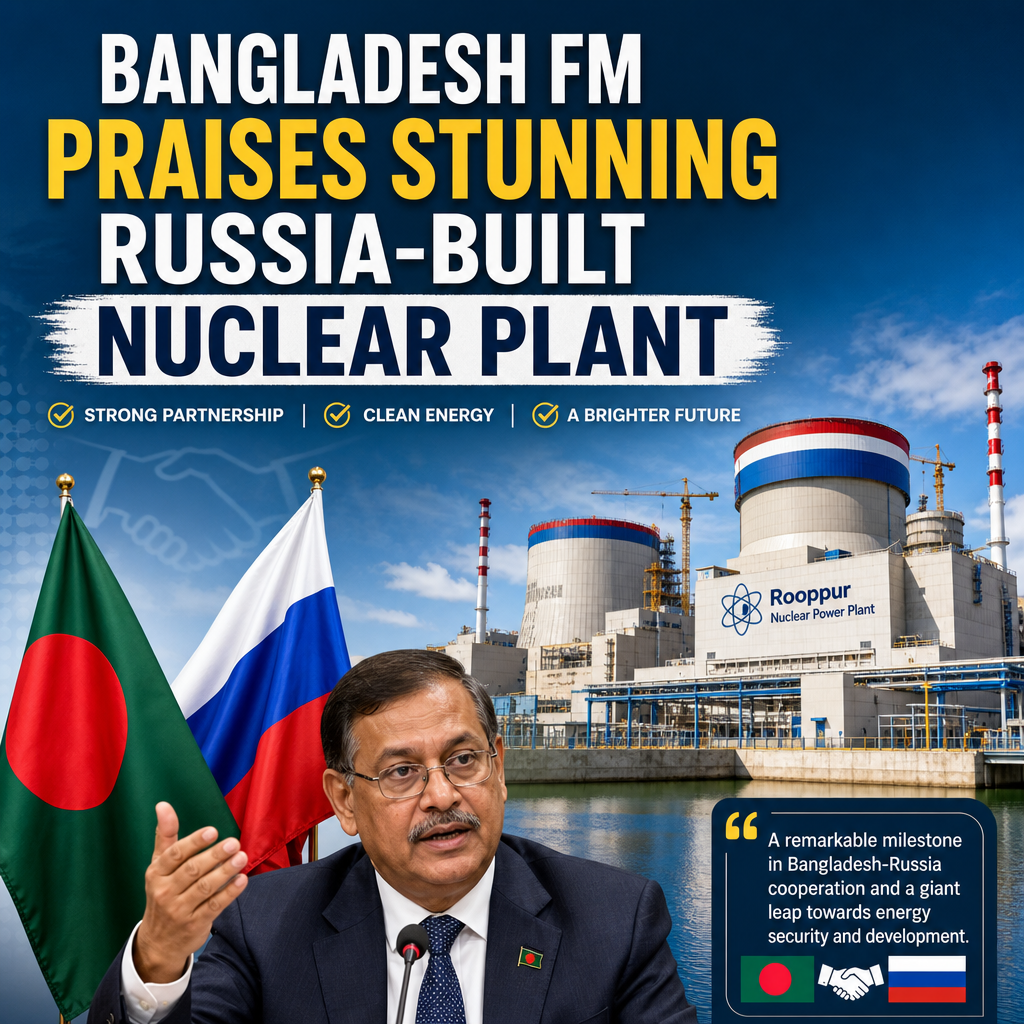
Bangladesh FM Praises Stunning Russia-Built Nuclear Plant


Bangladesh’s praise for the Russia-built nuclear plant has put a spotlight on a project that is both a symbol of ambition and a source of political debate.
At first glance, the message from Dhaka is straightforward: the country wants the Rooppur nuclear power plant to be seen as a major step toward energy security, industrial growth, and a more reliable electricity supply. But when the project is viewed through the wider lens of international reporting, it becomes clear that the story is more complicated than a simple success narrative. Reuters-style coverage from Russia’s state media presents the plant as a triumph of engineering and cooperation, while broader global reporting on Russia, nuclear safety, and Bangladesh’s development needs adds caution, context, and skepticism.



A flagship project with high stakes
Rooppur is Bangladesh’s first nuclear power plant, and that alone makes it historic. For a country where electricity demand has risen sharply over the last decade, the promise of a steady, low-carbon source of power is attractive. Supporters argue that nuclear energy could reduce dependence on imported fossil fuels, help stabilize prices, and support long-term economic growth.
That is likely why Bangladesh’s foreign minister’s praise matters: it reinforces the government’s view that the project is not just a technical achievement, but a strategic one. In public remarks reflected in Russian coverage, the plant is framed as evidence of productive bilateral cooperation and a milestone for Bangladesh’s future energy mix.




There is a clear appeal in that argument. Bangladesh is vulnerable to global fuel price swings, and like many fast-growing economies, it faces pressure to expand electricity access without dramatically worsening emissions. Nuclear power offers a rare combination of large-scale output and low direct carbon emissions. In theory, it can fit neatly into a development plan that seeks both growth and climate responsibility.
Still, theory is not the same as practice. Nuclear projects are among the most expensive and politically sensitive infrastructure investments any country can make. They require strict regulation, trained personnel, long-term waste management plans, and a safety culture that cannot be improvised.
What the different sources emphasize
The different news feeds bring out different parts of the story.
– RT’s framing tends to highlight the success of Russian engineering and diplomacy, portraying the plant as a showcase for Moscow’s role as a global nuclear builder.
– Al Jazeera’s broader regional and international reporting often places major infrastructure projects inside the politics of dependence, sovereignty, and development trade-offs.
– Sky News’ global coverage frequently emphasizes risk, accountability, and the geopolitical context surrounding Russia’s international partnerships, especially since the war in Ukraine changed how many governments view Russian state-linked projects.
Together, these perspectives suggest that the plant is not only about electricity. It is also about influence. Russia has long used large infrastructure and energy projects to strengthen ties with foreign governments, and nuclear cooperation is one of the most durable forms of that relationship because it stretches across decades. If Rooppur continues operating as planned, Bangladesh will be tied to Russian technology, expertise, fuel arrangements, and maintenance support for years.
That dependence is not necessarily a problem in itself, but it is a strategic choice. Countries entering nuclear partnerships usually accept a long chain of obligations in exchange for the benefits. The question is whether the benefits outweigh the risks, and whether Bangladesh has enough institutional capacity to manage the plant independently over time.
Why supporters remain confident
Supporters of the project point to several advantages:
– Energy diversification: Nuclear power can reduce reliance on imported gas, coal, or oil.
– Stable baseload electricity: Unlike solar and wind, nuclear plants can provide continuous output.
– Climate benefits: It can support emissions reductions without sacrificing industrial expansion.
– Prestige and capability-building: A successful nuclear plant signals technical ambition and modernization.
For a government under pressure to show progress, these are powerful arguments. If the plant performs well, it could become a centerpiece of Bangladesh’s long-term energy strategy.
Why caution is still warranted
Even so, the enthusiasm should be tempered by a realistic understanding of nuclear power’s challenges. Cost overruns and delays are common in nuclear construction around the world. Safety concerns also remain central, especially in densely populated regions or in countries where regulatory institutions are still evolving.
Bangladesh has already faced questions over preparedness, financing, and environmental risk. Nuclear energy may be cleaner in terms of carbon emissions, but it is not “simple” energy. It requires emergency planning, public trust, waste storage, and a transparent chain of oversight. Those issues do not disappear once a plant is inaugurated.
And then there is geopolitics. Russia’s image in many global media outlets has been shaped by its actions far beyond the energy sector, especially in Ukraine. That creates an added layer of scrutiny around any major Russian-built project. Even if the plant itself is technically sound, the partnership is being judged in a world where Russia’s state-linked projects are no longer viewed through a neutral lens.
That is why the tone of the coverage matters. Russian outlets highlight accomplishment and friendship. International outlets are more likely to ask whether the project creates vulnerability, whether the financing is sustainable, and whether Bangladesh is getting long-term resilience or long-term reliance.
A fair conclusion
The most balanced reading is that Bangladesh’s embrace of the plant is neither naïve nor unqualifiedly wise; it is a calculated bet. The government sees nuclear power as a route to stability, industrial growth, and lower emissions. That rationale is credible. But the project also binds Bangladesh to a powerful external partner and places immense responsibility on domestic institutions to manage safety, transparency, and technical competence over decades.
So the praise makes sense, but it should not be mistaken for the end of the conversation. Rooppur is a major achievement only if it delivers reliable power safely and sustainably. Until then, it remains what large infrastructure projects often are: a mix of promise, politics, and pressure, with the final verdict still years away.